Benjolin And The Secret Sauce
Benjolin and the Secret Sauce
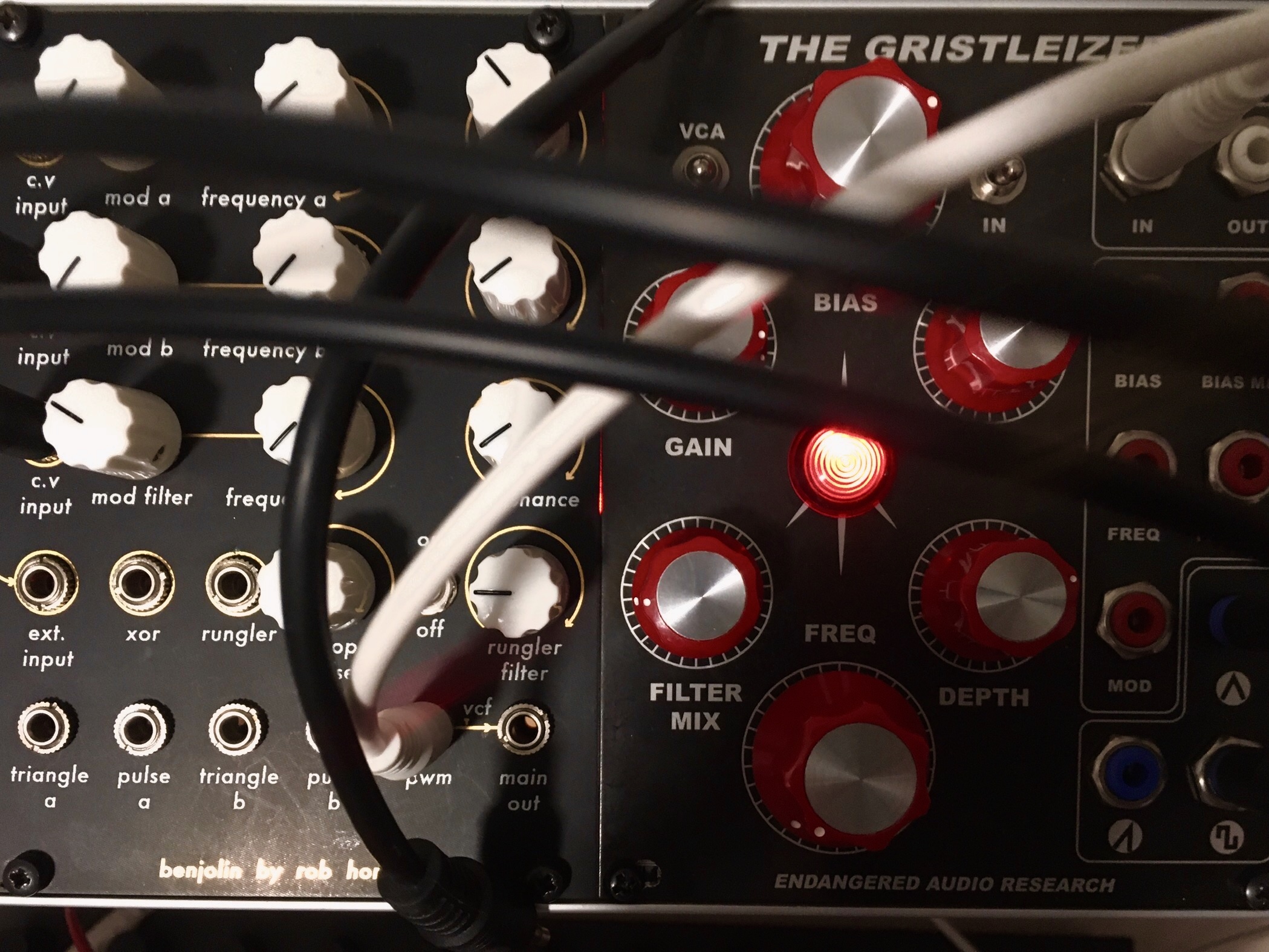
The Benjolin is one of the most revered and chaotic modules in the Eurorack world. Designed by the Dutch synthesizer pioneer Rob Hordijk, it stands as a prime example of “bent by design” philosophy—intentionally embracing instability, feedback, and unpredictability to create rich, evolving soundscapes from a compact circuit.Hordijk, a legendary figure in experimental electronic music and DIY synth communities, created the Benjolin around 2009 as an open-source project. He released schematics and encouraged builders to construct and modify it, leading to numerous DIY versions, workshops, and commercial adaptations. While originally conceived in formats like 5U (Moog-unit) or standalone boxes, it quickly became a favorite in Eurorack through builders like Epoch Modular, Klangbau Köln, and later official-ish collaborations.Core ArchitectureAt its heart, the Benjolin is a self-contained chaotic voice built around four main functional blocks: ![[Benjolin-Gristleizer.jpg]]
- Two Voltage-Controlled Oscillators (VCOs): These are triangle-core oscillators with wide frequency ranges. Oscillator 1 typically acts as the “modulator,” while Oscillator 2 is the “carrier,” but they cross-modulate each other heavily. Both produce triangle, square/pulse, and sometimes saw-like outputs.
- State-Variable Filter: A classic multimode filter (low-pass, high-pass, band-pass) with resonance that can self-oscillate. It processes signals from the oscillators and rungler, often fed by XORed pulse waves derived from the triangle outputs of both VCOs.
- The Rungler: This is the famous secret sauce—the circuit Rob Hordijk invented. It’s a shift-register-based pseudo-random generator (similar in spirit to the Turing Machine but distinct). It uses:
- Oscillator 2’s pulse as clock.
- Oscillator 1’s triangle (through a comparator) XORed with the shift register’s end as data input.
- Outputs stepped, chaotic CV (often 8 levels from 3 bits) and gates that can loop, evolve slowly, or burst into noise.
- Feedback Loops and Cross-Modulation: Built-in patch points allow deep internal feedback, where the rungler modulates oscillator frequencies, filter cutoff, or even itself, creating feedback chaos.
The result is a module that can go from droning ambient textures and metallic percussion to wild, alien melodies, noisy storms, and evolving pseudo-random sequences—all often without external CV input.Why the Benjolin Is Legendary
- Chaos as Composition Tool: Unlike predictable sequencers, the rungler generates patterns that feel alive—sometimes repeating loops, sometimes mutating slowly, sometimes pure noise. It’s perfect for generative music, much like the Krell Patch but more compact and self-contained.
- “Bent by Design”: Hordijk designed instability into the circuit on purpose. Slight tweaks to knobs push it from musical to extreme, encouraging exploration rather than precision.
- Versatility: It excels as:
- A standalone “noise box” for drones and textures.
- A modulation source (rungler CV/gates to drive other modules).
- A chaotic voice in larger systems.
- A percussive or melodic generator when patched carefully.
Eurorack ImplementationsSeveral builders have adapted the Benjolin to Eurorack:
- Epoch Modular Benjolin — One of the earliest and most authentic Eurorack versions, with patch points for deep access.
- After Later Audio Benjolin V2 (latest revision, in collaboration with Hordijk): Features reworked oscillators and filter for better Eurorack levels, improved gain staging, dual clock modes, expanded step options (8/16 or 127), and a more robust patch bay. Widely regarded as the “definitive” modern take.
- DIY versions (Klangbau Köln, Buck Modular, etc.) — Popular among builders, often with custom panels.
- Variants like Jolin’s BE2N (dual Benjolin in one module) push the concept further.
Typical size is 12–18 HP, depending on the builder, with generous patch points for integration.Tips for Using the BenjolinStart simple: Tune the oscillators slowly, crank the rungler rate, and let feedback build. Small knob movements yield huge changes—it’s unforgiving but rewarding. Patch the rungler CV to external modules for polyrhythmic modulation, or use it standalone for hours of evolving sound. For calmer results, slow the rungler and dial back resonance; for aggression, push everything to extremes.Videos like The Tuesday Night Machines’ classic explanation (with a Klangbau version) or deep dives into the After Later V2 remain essential viewing for newcomers.In the Eurorack ecosystem, the Benjolin occupies a unique niche: not a traditional oscillator/filter combo, but a chaotic ecosystem in 12–22 HP. It’s a module that rewards patience, rewards curiosity, and often surprises even seasoned users with new behaviors. If you’re drawn to generative, West Coast-inspired, or just plain weird synthesis, the Benjolin—courtesy of Rob Hordijk’s genius—is hard to beat.